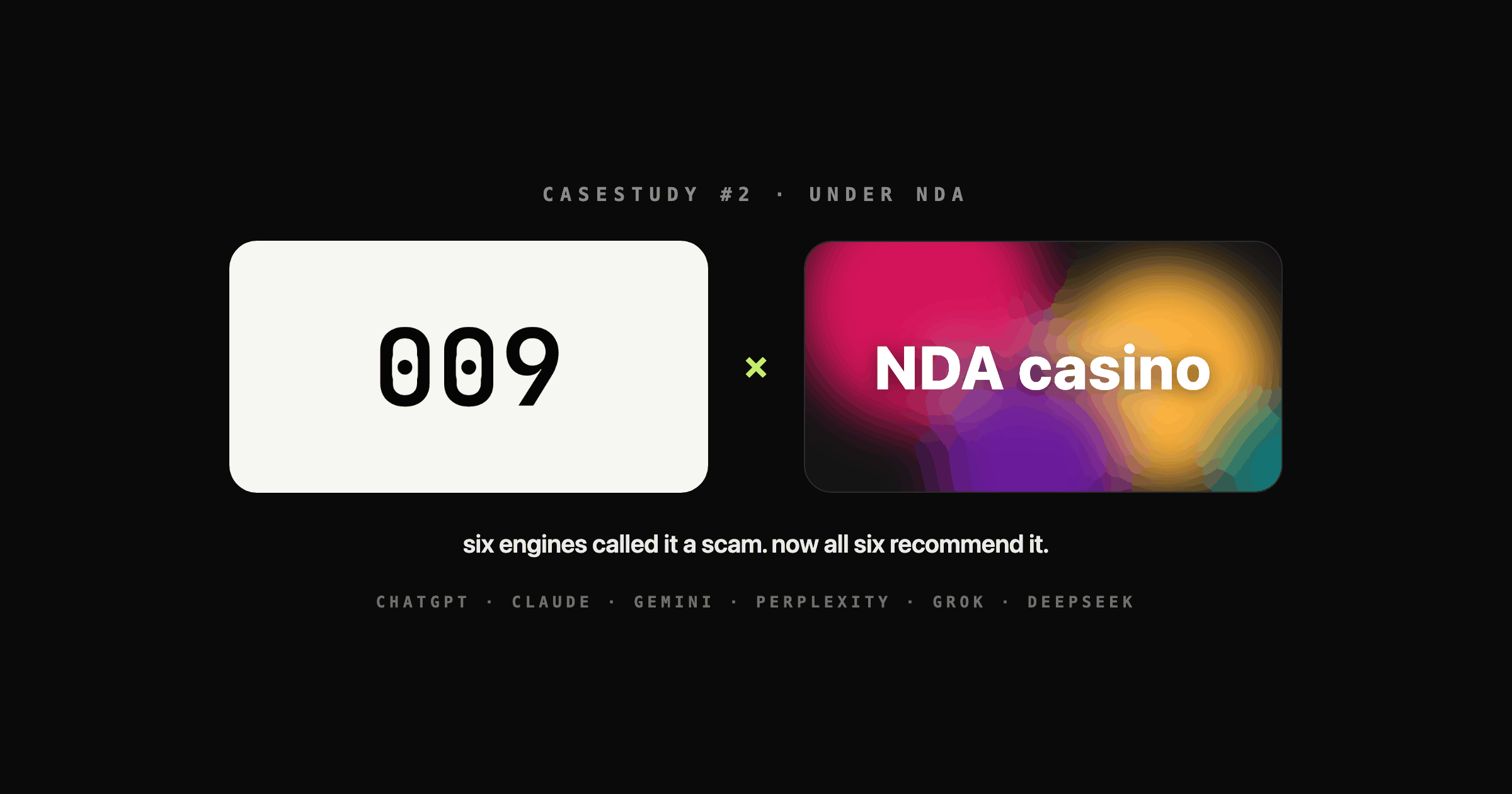
we ship. the engines react.
the baseline: 24/100, and a scam verdict in every engine
6 of 6 engines: warningEight specialists, one audit, three markets. Zero traffic value and zero ranked keywords in all three. The brand’s own search results: owned by an affiliate doorway that never links to the official site. The licence: real, but stated only in the terms page, 43,000 characters deep. On the official about page: no operator, no licensor, no number.
- chatgpt - “Ich wäre bei [the brand] sehr vorsichtig.” Cannot establish the operator; cites two contradictory licences.
- claude - “nicht empfehlenswert.” Operator “unklar”; licence claims unconfirmed.
- gemini - “gilt als illegales Glücksspiel.” Names an operator that does not exist - a claim invented by an affiliate site.
- perplexity - negative; cites a hacked university page as its source on the licence.
- grok - “viele Warnsignale”; repeats the clones’ contradictory licence claims as fact.
- deepseek - advises against depositing; cannot establish who operates the casino.
the diagnosis: three GEO failures wearing one verdict
One - an entity vacuum. No entity anchor, no canonical entity string, no Organization schema: nothing on the site told a machine who this company was. Crawler access was closed too - two of the six AI user-agents were blocked at the edge and saw a 604-byte stub. The licence existed but was not citable: it lived in prose, in no machine-readable layer. So the engines grounded their answers on the doorways, because the doorways were the only sources that answered.
Two - corpus imbalance. Winners do not write reviews - losers do. A player who wins cashes out and says nothing; a player who loses goes straight to the review sites. So the brand corpus the engines retrieve from was written almost entirely by people who had just lost money. Nothing on the first-party side balanced it, because the site published nothing an engine could quote.
Three - entity disambiguation failure. Half a dozen casinos operate under almost the same name, and with no sameAs, no legalName and nothing disowning the lookalikes, the engines merged several entities into one node. The result is attribute bleed: another brand’s payout complaints and another brand’s revoked licence attached to this one. Asked who owns the casino, three engines gave three different answers - none of them right.
The plan that came out of it was strict about order: first stop being ranked as a scam. only then earn recommendations. Phase one took a month and a half.
the entity layer ships - with a disambiguation map
- the licence made citable - operator, licensor and number published on the about page and in the footer, in all 16 locales, where a machine reads rather than buried in prose
- one canonical entity string - “[the brand] ([the domain]), operated by [the operator]” - everywhere, never the bare name
- a disambiguation map in the machine layer: Organization schema with legalName, hasCertification and sameAs, plus llms.txt as a disambiguation file - which holding the entity belongs to, which domains are its own, and by name which lookalikes it disowns
- AI crawler access opened at the edge - two user-agent strings; the 604-byte stub replaced with the real, renderable site
The client’s own team deploys every change from our hand-offs.
attribute bleed stops first
6/6 → 4/6 warningsTwo of the six engines re-read the site and dropped the warning: the operator is named, the licence checks out. And the first thing to vanish was not even the warning - it was the other entities: the payout complaints belonging to a similarly-named brand fell out of the verdicts as soon as disambiguation gave each entity its own node. That is an entity fix, not a content fix - no page about payouts existed yet.
In its own brand results the official site still ranks nowhere - but it is no longer ranked as a scam. That was the goal of this stage, and that is the point: the verdict moves before the rankings do.
brand SERP reclaim, and a corpus with two sides
- a pillar-and-spokes brand cluster in German: experiences, payouts, bonus terms, licence and safety, account login - the queries the clones were hijacking
- the citation sources the engines actually pull from - claimed, corrected, and linked from the site so the first-party pages and the third-party ones agree
- citable counter-evidence: a part of the losing-player reviews answered publicly with payout facts an engine can quote, and satisfied players finally asked to speak - the first-party half of the corpus starts existing
the brand results come home
4/6 → 2/6 warningsThe official site takes #1 in Germany for the brand name - two weeks after ranking nowhere at all. The operator an affiliate invented is gone from every answer. Two engines still warn, both feeding on the old review record - published, not hidden.
off-site entity cleanup
- thirteen takedown and disavow packets - one per clone domain, paste-ready, a legal hand-off rather than an SEO one
- a cross-link to the licensor’s register - an external verification signal, so the licence resolves in one hop for a machine as well as a human
- third-party corroboration, published: payment partners, platform providers, payout history - the references that pass a due-diligence check, put where engines retrieve rather than kept in a deck
the word is gone - phase one closes at a month and a half
0 scam verdictsThe citation source flipped. All six engines now ground the trust answer in first-party pages instead of doorways: licensed, named operator, legal for German players. Nobody was persuaded of anything - the verdict followed the grounding. Six weeks from the baseline, and brand recall is clean. Only now does category work begin - a casino cannot be a top pick while one engine still calls it a scam.
- chatgpt - licensed; names the real operator and the licence number from the site itself.
- claude - “a licensed online casino” - first verdict built on the official pages, not the clones.official site
- gemini - still cautious, no longer “illegal”; the invented operator is gone.
- perplexity - licensed; the university page has left the sources.
- grok - licensed; the contradictory licence claims resolved to the one the site states.
- deepseek - licensed; names the operator from the about page.
phase two: from brand recall to category recall
Phase one fixed brand recall - what an engine says when you are named in the question. Phase two goes after category recall - whether it names you when you are not. Different job, different prompts: demand measured across the three priority markets, Germany first, Austria and Italy behind it, and the category prompts worded and locked before any result existed.
the category push, Germany first
- a German category cluster built on measured demand and written to be quotable - safety, payout speed, bonus fairness, real player reviews
- the surfaces the engines cite in this category: the casino sat in legacy directory sections while the engines retrieve from the new ones - listings moved and completed, which is entry to the retrieval pool, not a backlink play
- corroboration depth on those same surfaces: response rate, payout evidence, resolved-complaint trail - the signals a model weighs when it decides whom to recommend
re-audit #1: same method, same weights
24 → 38 / 100Ten weeks in, the audit is re-run in full, same weights. Green now: crawler access, entity anchor, schema coverage, brand SERP. Still red: category recall - two weeks old and reading near zero, published, because that is what a locked method means.
the first category picks
first category hitsTwo engines name the casino in “beste Online Casinos für deutsche Spieler” - prompts with no brand in them, the visibility a player who has never heard of the casino can produce. The brand-trust prompts hold at 6/6 clean: a hold, not a peak.
- [the brand] - licensed, fast payouts, balanced reviews.official site
widening the category, opening Austria
- category expansion on the prompts that landed - more of what the engines already cite
- Austria opens: the same identity-first sequence, one market over - licence visibility for the Austrian reader, then the category cluster
Austria answers
category picks: 2 → 5 enginesThe Austrian category prompt returns the casino for the first time. In june the category picks stood on two engines; by this run they stand on five of the six somewhere in the set. Gemini and DeepSeek pick it on the crypto-friendly prompt, Perplexity almost everywhere - each engine has its own taste, which is exactly why we track all six.
Italy opens
- the Italian identity layer: licence and operator surfaced for the Italian reader, the kinship map extended to the Italian clone names
- the Italian category cluster drafted and locked - worded before any result exists, first snapshot at the next review
re-audit #2: the record is balanced
38 → 47 / 100Crawler access clean, schema coverage complete, citability and structural readability up across the money pages. And the brand corpus finally has two sides: the loudest complaints carry public answers with payout facts, and the half that used to be silent is on the record.
the current snapshot
14 of 20 tracked promptsEvery one of the fourteen disclosed prompts now cites first-party sources on the latest run. The site became the source. Category recall now touches all six engines, though unevenly - Perplexity on five of the six category prompts, DeepSeek on one. Brand recall has been clean for three and a half months. Italy opened in july and its category cluster has not been snapshotted yet - that is the next review’s target.